NORTHBORO – A two-year-old ban
on disposal of large amounts of commercial food waste from getting into
the state’s solid waste stream may be producing some unintended
consequences, but top state officials who may be able to resolve the
problems are saying little to allay fears of farmers and homeowners
affected by the ban.
Windrow composting is a very well established technology for dealing withfood & kitchen waste, agricultural & green wastes, and also Municipal Solid Waste (MSW). The material is shredded and then piled in elongated rows (windrows) and aerated through either turning of the windrows or by forcing air through the material. Windrow composting may take place in buildings or externally.
-Long, narrow piles agitated/turned regularly. -Aeration by natural/passive air movement. -Better suited to larger volumes. -Composting time: 3 - 6 Months.
Production of high-quality organic granulated fertilizer is a complex task as the process is subject to various factors: variety and quality of raw materials, composition and compatibility of material formulation, moisture content and its variation during the organic fertilizer granulation process, quality and degree of abrasion of the operating parts of the grinder and the granulator used, correct selection and setting of equipment operating modes, etc. This means that producers of organic granulated fertilizers need to take into account all the elements and stages of the technological process of granulation. In a competitive market, this cannot be overlooked or ignored. In the granulation process, there are several factors affecting the quality of the final (new) product. Some authors claim the quality of granulated product is mostly affected by the composition of granules (20 %), pressing quality 15 %, material shredding parameters up to 20 %, additional processing approximately 40 %, as well as the drying cooling process.
It is indisputable that part of soil fertility improvement is organic fertilizer. The main source of
organic fertilizer remains livestock waste – cattle and poultry manure. Whereas scarcely used, when
the price of mineral fertilizer increased and ecological problems appeared, a decrease of soil fertility
and humus has been noticed.
When applying conventional manure removal, preparation and application methods in addition to
not using stricter environmental requirements can have a negative impact on the key components of
the environment. This can be prevented by properly wasting, composting and granulating agricultural
waste. The resultant product is humus compost, which presents no problems and no the difficulty of
keeping it and has no unpleasant odor, pathogenic organisms or other fitotoxical materials, it also
accelerates the metabolism of nutrients between the soil and plant roots of plants.
Organic granular fertilizer improves the dynamics of microbiological processes in granules and
around them which allows reducing the spread of nutrients in the soil and their transition to less agile
forms, besides that it results in better circumstances for processes taking place between the fertilizer,
soil and plant.
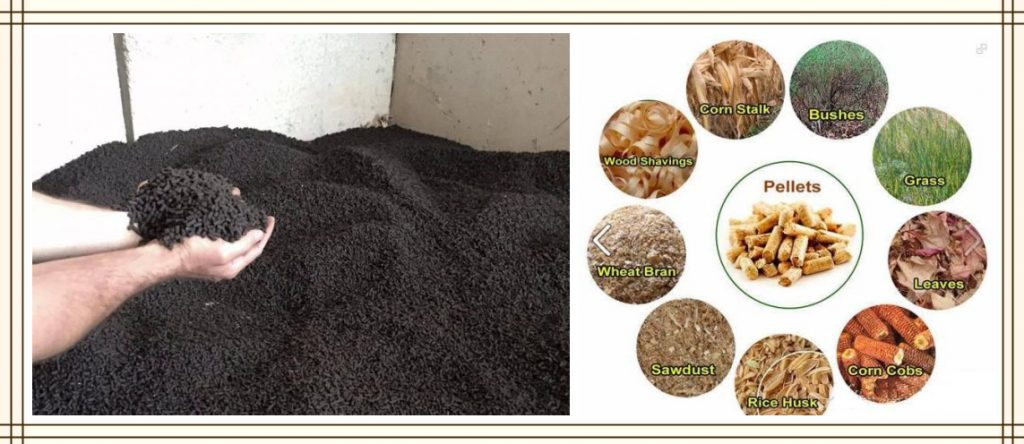
Granular manure is a universal complex organic fertilizer containing all the macro and micro
elements. Pelleted manure nutrient content for soil micro flora is optimal; moreover, it quickly
dissolves in water and is easily absorbed by plants. Granular manure can be called concentrated
fertilizer, because the recycling process reduces the volume of material more than 10 times, due to
water removal and material thickening while extruding.
Granulation – the set of natural and physical-mechanical processes, which take place during the
formation of little pieces, which has a dimension of the ranges, forms, structures and physical
properties. Granulation allows significant simplification of the storage, transport and dosage;
moreover, it increases powdery while together eliminating dusting and improving the working
conditions in the production sphere, besides that, it can regulate the granule structure and related
properties.
The granulation process efficiency depends on the method of granulation and technology.
The
consequence of all physical-mechanical processes that are taking place while pelleting is that
granulated material density increases.
In the manure pellets making process we can see all known physical-mechanical and physical-chemical
bonds, accompanied by such forces as the capillary force and forces between the solid particles, temperature changes affecting the
forces and so on.
The granulation process itself depends on the feedstock grain size and physical-mechanical
properties. (Temperature, moisture content, pH, etc.). The main parameter describing the performance
of pelletizer and the energy cost required by material compaction is the granule formation speed.
As the speed of granulation increases the granular material density and mechanical strength decrease.
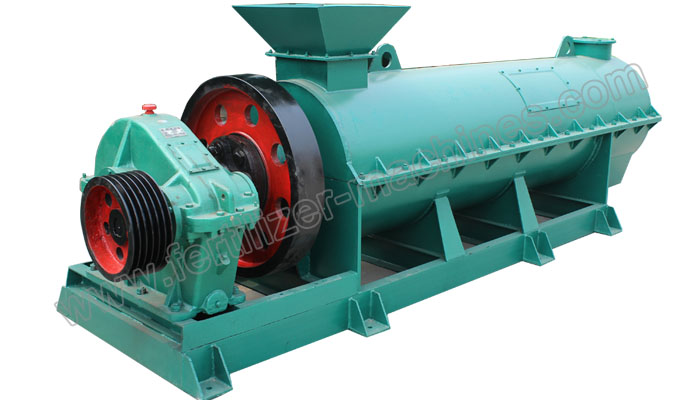
Organic fertilizer (biological) granulator
is in round configuration to make cylindrical particles a rolling ball,
no return, high rate of ball granule, good strength, beautiful and
applicable, and hence the machine becomes the ideal equipment of
globular particles in organic fertilizer (biological). India is a large
agricultural nation, there is lots of organic fertilizer, and many
villagers do not know how the rational use of fertilizers, resulting in a
lot of waste. So the demand for granulators is big. We are all know the modern organic fertilizer is produced by organic fertilizer equipment, the organic fertilizer production
has been mechanized, large-scale, integrated processing, below we went
into the production process of organic fertilizer equipment. The way of traditional organic fertilizer pelletizing is mainly through the disc for molding. Disc Pelletizer
through high speed revolves result the raw materials rolling in balls.
On the process of the molding, you need add some water to increase the
rate of shaping. So the organic fertilizer pellets would be a little
more loose, not hard, easy to broken and out of shape, This would bring some unnecessary risks on product organic fertilizer. The
production of organic fertilizer according to the organic fertilizer
functional effects decision, workers then first a variety of raw
materials required pulverized into a certain degree of fineness of
organic materials, in accordance with Formulation in a blender Hunban,
in this process, the key step is proportion to add a 'bio-fermentation
agents, Hunban into the fermentation tank, so the area is very small,
deep pool aerobic fermentation, the fermentation process without manual
saves fermentation costs due to full mechanization production,
fermentation so evenly, no dead ends, from the process to ensure product
quality organic fertilizer. After one night, the raw material input
temperature soon rose up, up to 70 degrees, this time, the staff start
turning throwing equipment, at the same time open the blast equipment,
to be turned toss after the end of the pond is already fermented
finished, new raw materials into the fermentation tank, and so the
cycle. Organic fertilizer granulator equipment
to show the production process, to understand and know how it carried
out the production of organic fertilizer, it helps to fully play its
fertilising application of organic manure.
Conventional methods of growing crops can produce up to 25 percent
more food than organic methods for cash crops such as wheat and corn.
Why then would anyone want to use organic fertilizer? Organic fertilizer
consists of natural materials from the remains of a once-living
organism or the by-products of an organism. Organic fertilizers provide a
steady release of nutrients for a very long time. Also, almost any organic material can be used as a fertilizer, though
the effectiveness of each will vary considerably. Unlike inorganic
fertilizers, living organisms eat organic matter in natural fertilizers,
which helps break down nutrients for plants to consume. They also allow
the soil to better hold moisture while promoting proper drainage. While
chemical fertilizers can sometimes not work on dead soil, organic
fertilizers help build nutrients that naturally replenish the soil, and
healthier soil leads to greater nutrition. Soil that is fertilized with inorganic materials will eventually die
as commercial fertilizers contain only enough nutrients to keep the
plants growing. As the soil begins to die, it is necessary to add even
more fertilizer to maintain the same nutrient levels to preserve the
plants. A study published in the May 2002 edition of Science revealed that
using organic fertilizer can cut down on the amount of fertilizer needed
by 34 to 53 percent, while reducing the need for pesticide use up to 97
percent. Commercial fertilizers are also filled with toxic chemicals that leak
into the water supply. They can poison local wildlife, kill surrounding
soil, and endanger the safety of those who live nearby. In fact, the
National Institutes of Health published a warning on plant fertilizer
poisoning due to high levels of nitrates. You can become infected not only by accidentally consuming them, but
also by regularly coming into contact with conventional fertilizers. If
you are a farmer or like to spend time in your food garden, this could
be a health and safety concern for you and your family. If you touch conventional fertilizer, you may experience burning
skin. If you consumed it by accident, you may experience an upset
stomach, pain in your abdomen, dizziness or shortness of breath. Organic
fertilizers, on the other hand, may sometimes smell putrid, but they
replenish soil, feed small organisms, and are safe to use. More Resources: 1. Organic Fertilizer Manufacturing Process 2. Small Scale Organic Fertilizer Plant Layout 3. Organic Fertilizer Production Line
Composting is an ancient art, as old as seed gathering and cave painting. Clay tablets from Mesopotamia dating back 1,000 years before Moses discuss the composting process. Composting was popular with the Greeks and Romans and was common farming practice in Europe and America before the chemical revolution of the 19th century. Beginning in 1905, the English agronomist Sir Albert Howard spent 30 years developing composting techniques in India, ideas which were then embraced by home gardeners in America thanks to the efforts of Organic Gardening editor J.J. Rodale and others.
Take your yard clippings for a spin! TheTumbleweed Compost Tumbleris a simple way to quickly turn yard and food waste into a homegrown soil amendment, quickly and cleanly. Drop the materials in, turn them a few times per week, and in months — not years — you’ll have gallons of nutrient-dense organic matter to offer your plants.
The first compost transaction — its transfer from party to party for trade or profit — is lost to history. The commercial sale of compost probably dates back to when some enterprising farmer began trading the fermented remains of his silage pile to a neighboring gardener for grain or produce. Colonial farmers of New England made a practice of throwing the surplus fish catch into piles of barnyard muck and it’s easy to think that some of the potent results were traded among growers who weren’t such able fisherman. Private, usually local commercial composting began on a small scale during the back-to-the-land movement of the 1970s (commercial humus, potting soils and such products as fish fertilizer have been around for decades). This practice grew as corporate farm operations, livestock growers, the timber industry and other businesses realized there was profit to be made from the waste of their activities.
As in Los Angeles, municipal compost operations started as an answer to rapidly filling landfill sites. Since leaves and yard wastes comprise such a large percentage of landfill volume, as much as 30 per cent depending on the season, many cities began to see the value of composting their green waste and recycling (Los Angeles reached 50 percent by including food, paper products and other soluble wastes).
The city of Davis, California has had such a program since 1972. Wellesley, Massachusetts began composting its leaves in the early 1970s after its community incinerator was closed for failing to meet air emission standards. At first, leaves were just piled and stored, but then the city began turning the huge piles and making finished compost and using it locally. Sales boomed. In the late ’80s, the town began collecting debris from landscapers and other commercial operations in an effort to triple their compost production. Other states began to see the win-win value of composting and passed laws to keep yard wastes out of landfills. Incentives were granted for backyard composting programs, subsidies were given to homeowners who purchased compost bins and cities were awarded funds for trucks that would vacuum up leaves.
As previously noted, the market potential determinations for both red grape skins and grape seed oil were based
on 100% utilization. These market potentials decrease when a large portion of the produced grape pomace is
used to create compost which is then recycled back into the vineyard.
Composting is based on aerobic microbial decomposition. Organic compounds are broken down (decomposed)
into natural elements such as carbon and nitrogen. This is a very simplified version of the composting process as
a multitude of factors are involved in composting biology and chemistry. For optimal composting, the material
being composted must have a high moisture content and contain a sufficient carbon-to-nitrogen (C:N) ratio. The
high C:N provides nutrients for the microbes to survive and continue degradation. A study
in 2001 provided the chemical characterization of fresh grape pomace, which is displayed in Table 15. The
chemical composition after composting is also displayed in Table 15, providing a before and after comparison of
grape pomace composting. The optimal initial C:N of a compost is between 25:1 and 35:1. As shown in Table 16, the C:N of grape pomace
is approximately 27:1, therefore it qualifies as an optimal substrate for composting. After composting, the
nitrogen content increased to 2.35 (wt%). This is beneficial as nitrogen content in soil is influential in determining vineyard growth.
The theoretical average amount of nitrogen needed for a vineyard is 55 kg N/ha. This is equivalent to 22.267 kg N/acre (1 ha = 2.47 acres). As
stated, the market potential of grape pomace as a suitable supplement decreases as increased pomace is utilized
as compost. Although composting grape pomace increases the nitrogen content, using composted grape pomace
alone to supply vineyards with nitrogen is neither feasible nor economical. To validate 1) due to the significant
amount of composted grape pomace needed to supply 22.267 kg N/acre and 2) the other nutrients needed for
vineyard growth, i.e., phosphorus, potassium and magnesium, are not adequately supplied by grape pomace
compost.