Conventional methods of growing crops can produce up to 25 percent
more food than organic methods for cash crops such as wheat and corn.
Why then would anyone want to use organic fertilizer? Organic fertilizer
consists of natural materials from the remains of a once-living
organism or the by-products of an organism. Organic fertilizers provide a
steady release of nutrients for a very long time. Also, almost any organic material can be used as a fertilizer, though
the effectiveness of each will vary considerably. Unlike inorganic
fertilizers, living organisms eat organic matter in natural fertilizers,
which helps break down nutrients for plants to consume. They also allow
the soil to better hold moisture while promoting proper drainage. While
chemical fertilizers can sometimes not work on dead soil, organic
fertilizers help build nutrients that naturally replenish the soil, and
healthier soil leads to greater nutrition. Soil that is fertilized with inorganic materials will eventually die
as commercial fertilizers contain only enough nutrients to keep the
plants growing. As the soil begins to die, it is necessary to add even
more fertilizer to maintain the same nutrient levels to preserve the
plants. A study published in the May 2002 edition of Science revealed that
using organic fertilizer can cut down on the amount of fertilizer needed
by 34 to 53 percent, while reducing the need for pesticide use up to 97
percent. Commercial fertilizers are also filled with toxic chemicals that leak
into the water supply. They can poison local wildlife, kill surrounding
soil, and endanger the safety of those who live nearby. In fact, the
National Institutes of Health published a warning on plant fertilizer
poisoning due to high levels of nitrates. You can become infected not only by accidentally consuming them, but
also by regularly coming into contact with conventional fertilizers. If
you are a farmer or like to spend time in your food garden, this could
be a health and safety concern for you and your family. If you touch conventional fertilizer, you may experience burning
skin. If you consumed it by accident, you may experience an upset
stomach, pain in your abdomen, dizziness or shortness of breath. Organic
fertilizers, on the other hand, may sometimes smell putrid, but they
replenish soil, feed small organisms, and are safe to use. More Resources: 1. Organic Fertilizer Manufacturing Process 2. Small Scale Organic Fertilizer Plant Layout 3. Organic Fertilizer Production Line
Composting is an ancient art, as old as seed gathering and cave painting. Clay tablets from Mesopotamia dating back 1,000 years before Moses discuss the composting process. Composting was popular with the Greeks and Romans and was common farming practice in Europe and America before the chemical revolution of the 19th century. Beginning in 1905, the English agronomist Sir Albert Howard spent 30 years developing composting techniques in India, ideas which were then embraced by home gardeners in America thanks to the efforts of Organic Gardening editor J.J. Rodale and others.
Take your yard clippings for a spin! TheTumbleweed Compost Tumbleris a simple way to quickly turn yard and food waste into a homegrown soil amendment, quickly and cleanly. Drop the materials in, turn them a few times per week, and in months — not years — you’ll have gallons of nutrient-dense organic matter to offer your plants.
The first compost transaction — its transfer from party to party for trade or profit — is lost to history. The commercial sale of compost probably dates back to when some enterprising farmer began trading the fermented remains of his silage pile to a neighboring gardener for grain or produce. Colonial farmers of New England made a practice of throwing the surplus fish catch into piles of barnyard muck and it’s easy to think that some of the potent results were traded among growers who weren’t such able fisherman. Private, usually local commercial composting began on a small scale during the back-to-the-land movement of the 1970s (commercial humus, potting soils and such products as fish fertilizer have been around for decades). This practice grew as corporate farm operations, livestock growers, the timber industry and other businesses realized there was profit to be made from the waste of their activities.
As in Los Angeles, municipal compost operations started as an answer to rapidly filling landfill sites. Since leaves and yard wastes comprise such a large percentage of landfill volume, as much as 30 per cent depending on the season, many cities began to see the value of composting their green waste and recycling (Los Angeles reached 50 percent by including food, paper products and other soluble wastes).
The city of Davis, California has had such a program since 1972. Wellesley, Massachusetts began composting its leaves in the early 1970s after its community incinerator was closed for failing to meet air emission standards. At first, leaves were just piled and stored, but then the city began turning the huge piles and making finished compost and using it locally. Sales boomed. In the late ’80s, the town began collecting debris from landscapers and other commercial operations in an effort to triple their compost production. Other states began to see the win-win value of composting and passed laws to keep yard wastes out of landfills. Incentives were granted for backyard composting programs, subsidies were given to homeowners who purchased compost bins and cities were awarded funds for trucks that would vacuum up leaves.
As previously noted, the market potential determinations for both red grape skins and grape seed oil were based
on 100% utilization. These market potentials decrease when a large portion of the produced grape pomace is
used to create compost which is then recycled back into the vineyard.
Composting is based on aerobic microbial decomposition. Organic compounds are broken down (decomposed)
into natural elements such as carbon and nitrogen. This is a very simplified version of the composting process as
a multitude of factors are involved in composting biology and chemistry. For optimal composting, the material
being composted must have a high moisture content and contain a sufficient carbon-to-nitrogen (C:N) ratio. The
high C:N provides nutrients for the microbes to survive and continue degradation. A study
in 2001 provided the chemical characterization of fresh grape pomace, which is displayed in Table 15. The
chemical composition after composting is also displayed in Table 15, providing a before and after comparison of
grape pomace composting. The optimal initial C:N of a compost is between 25:1 and 35:1. As shown in Table 16, the C:N of grape pomace
is approximately 27:1, therefore it qualifies as an optimal substrate for composting. After composting, the
nitrogen content increased to 2.35 (wt%). This is beneficial as nitrogen content in soil is influential in determining vineyard growth.
The theoretical average amount of nitrogen needed for a vineyard is 55 kg N/ha. This is equivalent to 22.267 kg N/acre (1 ha = 2.47 acres). As
stated, the market potential of grape pomace as a suitable supplement decreases as increased pomace is utilized
as compost. Although composting grape pomace increases the nitrogen content, using composted grape pomace
alone to supply vineyards with nitrogen is neither feasible nor economical. To validate 1) due to the significant
amount of composted grape pomace needed to supply 22.267 kg N/acre and 2) the other nutrients needed for
vineyard growth, i.e., phosphorus, potassium and magnesium, are not adequately supplied by grape pomace
compost.
Our EFB composting system offers an effective solution to the oil palm industry's problem of waste disposal. The palm oil waste composting system utilizes 100% POME and EFB and uses a technically advanced method of converting waste matters into compost. Part of the process involve EFB shredding using a high speed hammer mill and then stacked into windrows of 1.5 meter high by 45 meter length in an open field. POME with BOD levels less than 10,000 ppm is then pumped from the pond and sprayed onto these windrows at a specified rate at 3 days intervals. The windrows are turned regularly using a windrow turner for better mixing and aeration. Composting accelerates are sprayed once at the start of the process to accelerate the composting process. Throughout the composting process, the windrows are covered by an air-permeable covering to avoid drenching by heavy rain and to prevent leaching of nutrients. The covering is crucial for the control of temperature and moisture content, two key factors that affect the speed of composting and quality if the end product. The compost is mature after 70 days and is ready for use. The compost, when used in sufficient quantity, is capable of replacing 66% of chemical fertilizers.
In the middle of farms and fields, south of Bakersfield CA, in the
small town of Lamont CA is one of the largest composting facilities in
the United States. Driving from downtown LA, it took me 2.5 hours to
make it out to the facility. Just like the surrounding farms, this
facility has rows and rows of crops – except this crop is compost.
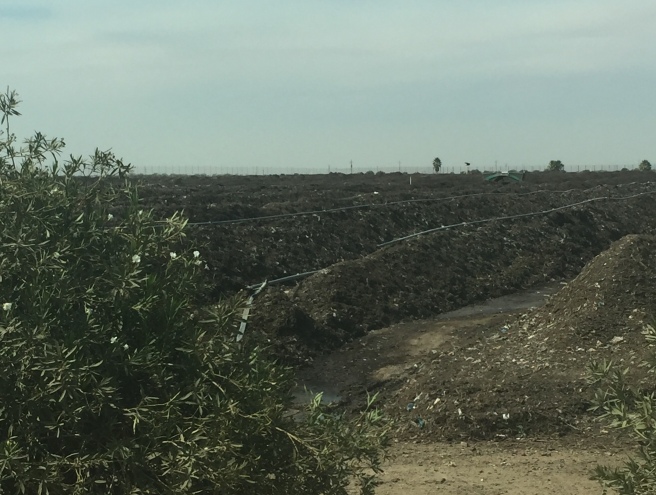
Specifically, windrow composting – where heaps of organic waste,
organized into rows, sits for 4 months as it slowly turns into compost.
Windrow composting involves a few major steps: Collection, Feedstock
Preparation, Windrow Processing and, Screening.
Collection:
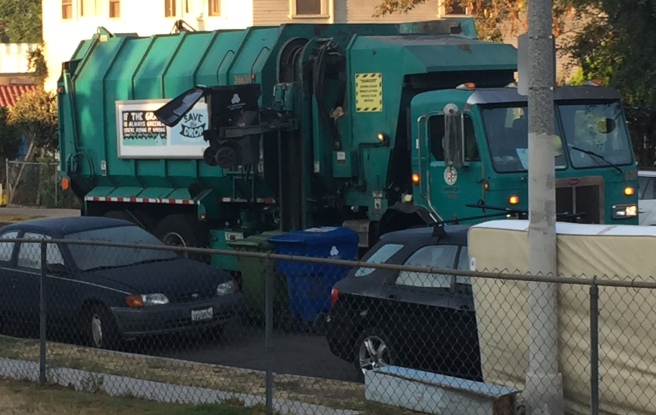
Before material even makes it to Lamont, it must be collected. It sounds
simple but complexities exist. Material originates not only from the
bin placed out at the curb in residential neighborhoods but from several
different sources and even that bin can be complex. Some residential
bins collect yard waste only while some collect yard waste & food
scraps. The composition or profile of the waste varies differently when
food scraps are added and changes depending on neighborhood.
Additionally, most of the waste comes from commercial and farm sources –
again with its own profile. All these sources arrive at the Lamont
facility via different pathways. Residential and some commercial
material is received at Recology’s Sun Valley MRF. Other commercial and
farm wastes arrive directly at the Lamont facility from various sources
(other MRFs, farmers truck it in themselves, etc.) Early morning collection in East Los AngelesFeedstock Preparation:
Successful composting starts with the Carbon to Nitrogen (C:N ratio) of
the feedstock. Yard trimmings have a high ratio and food waste has a
low ratio. Mixing brings the ratio within the ideal C:N ratio of
20-40:1. The Sun Valley MRF mixes the collected feedstock to be
composted at Lamont. see more information on COMPOSTABLE MATERIALS AROUND US
Windrow Processing:
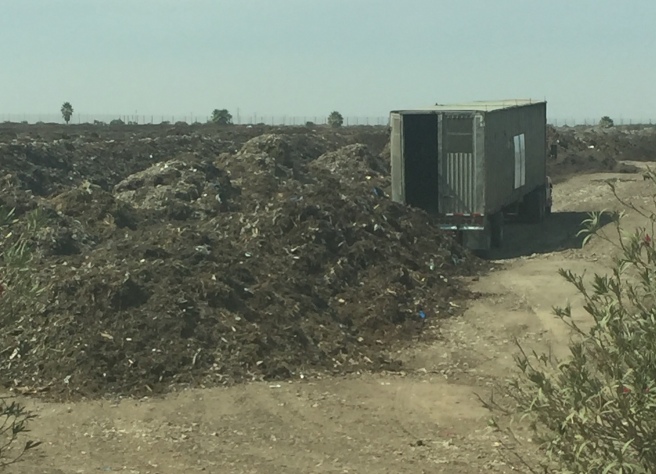
The Lamont facility is the largest permitted composting facility west
of the Mississippi. Every day, 150 tractor-trailers unload tons of
organics. The logistics behind such a large scale operation can seem
harrowing but the standard in large scale composting is to form windrows
– long rows of material dumped out of the back of the tractor trailer
and left in the field. Composting starts where the materials lies! Several truckloads make a completed windrow which can be a couple
hundred feet long. Once unloaded, the material must be covered with dirt
to contain any gasses. And the windrow must be watered – with an ideal
moisture content between 40-60%. The Lamont facility uses gray, filtered
but untreated water from the Lamont wastewater plant. In addition to
adding moisture, the water serves to further reduce the C:N ratio. Initially, the row is a lumpy mess but the material must be turned to
aerate the material. Aeration occurs every 3 days during the first 15
days, with a reduction in frequency after the first 15 days. To aerate, a
giant windrow turner straddles a row and churns the material as it
drives over the row. As the turner passes, the row is processed into a
neat pile. The entire composting process takes about 120 days. Throughout the
process, the temperature is measured o ensure pathogens are destroyed
and the compost is safe to use. Temperature is also a key insight into
how the composting process is performing. With windrow composting, the long processing time of 120 days
requires large amounts of land. In vessel composting is a popular
alternative in space constrained areas as it requires less space and
completes the process in a shorter amount of time with greater control
of environment for more precise conditions for composting.
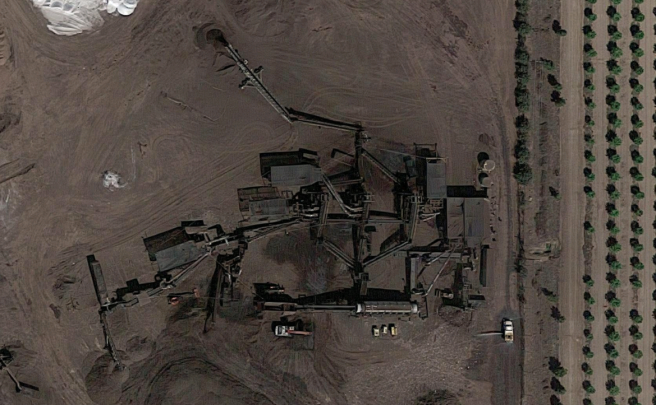
Screening: At
the end, most of the material will have processed into very small
particles. But, plastic bags, nails, large pieces of wood which didn’t
fully decompose will have to be removed. Material is loaded into a
hopper which screens out particles larger than about 4 inches. Then the
material is moved through a large rotating cylindrical tube with many
holes on an incline – called a trommel screen. Properly sized material
slips through the holes while oversized material continues to travel up
the trommel, ending in the overs bin. The overs are sent to landfill.
Prime material undergoes further screening: a magnet is passed over the
material to capture ferrous metals (mostly nails left in trees) and a
stream of air is passed through the material and into a vacuum to
capture any plastic film material. Prime compost is sold to surround
area farms. Screening at Blossom Valley (trommel screen is seen in bottom center of the equipment)
I initially thought compost was equivalent to dirt but the
classification is different. Compost is a soil amendment and is able to
provide nutrients and microbes which have been depleted during
traditional farming techniques. It also absorbs and retains much more
liquid than just soil alone. This is great for drought stricken areas
like the Central Valley, where the facility is located. The tour gave me
a much greater appreciation of what is involved in processing our
organics. The system is much more complex than people initially assume.
Organic fertilizer granulator is in round configuration to make cylindrical particles a rolling ball, no return, high rate of ball granule, good strength, beautiful and applicable, and hence the machine becomes the ideal equipment of globular particles in organic fertilizer (biological). India is a large agricultural nation, there is lots of organic fertilizer, and many villagers do not know how the rational use of fertilizers, resulting in a lot of waste. So the demand for granulators is big.
We are all know the modern organic fertilizer is produced by organic fertilizer equipment, the organic fertilizer production has been mechanized, large-scale, integrated processing, below we went into the production process of organic fertilizer equipment.
The way of traditional organic fertilizer pelletizing is mainly through the disc for molding. Disc Pelletizer through high speed revolves result the raw materials rolling in balls. On the process of the molding, you need add some water to increase the rate of shaping. So the organic fertilizer pellets would be a little more loose, not hard, easy to broken and out of shape,
This would bring some unnecessary risks on product organic fertilizer.
The organic fertilizer production according to the organic fertilizer functional effects decision, workers then first a variety of raw materials required pulverized into a certain degree of fineness of organic materials, in accordance with Formulation in a blender Hunban, in this process, the key step is proportion to add a 'bio-fermentation agents, Hunban into the fermentation tank, so the area is very small, deep pool aerobic fermentation, the fermentation process without manual saves fermentation costs due to full mechanization production, fermentation so evenly, no dead ends, from the process to ensure product quality organic fertilizer. After one night, the raw material input temperature soon rose up, up to 70 degrees, this time, the staff start turning throwing equipment, at the same time open the blast equipment, to be turned toss after the end of the pond is already fermented finished, new raw materials into the fermentation tank, and so the cycle.
Organic fertilizer granulator equipment to show the production process, to understand and know how it carried out the production of organic fertilizer, it helps to fully play its fertilising application of organic manure.